The Deeper Pattern Behind Human Conflict
Part 1 of 2: Looking beneath human conflict at the ideas, goals, and beliefs that shape it—and asking whether there is a moral foundation beneath them all.
 Words by Attuned Mind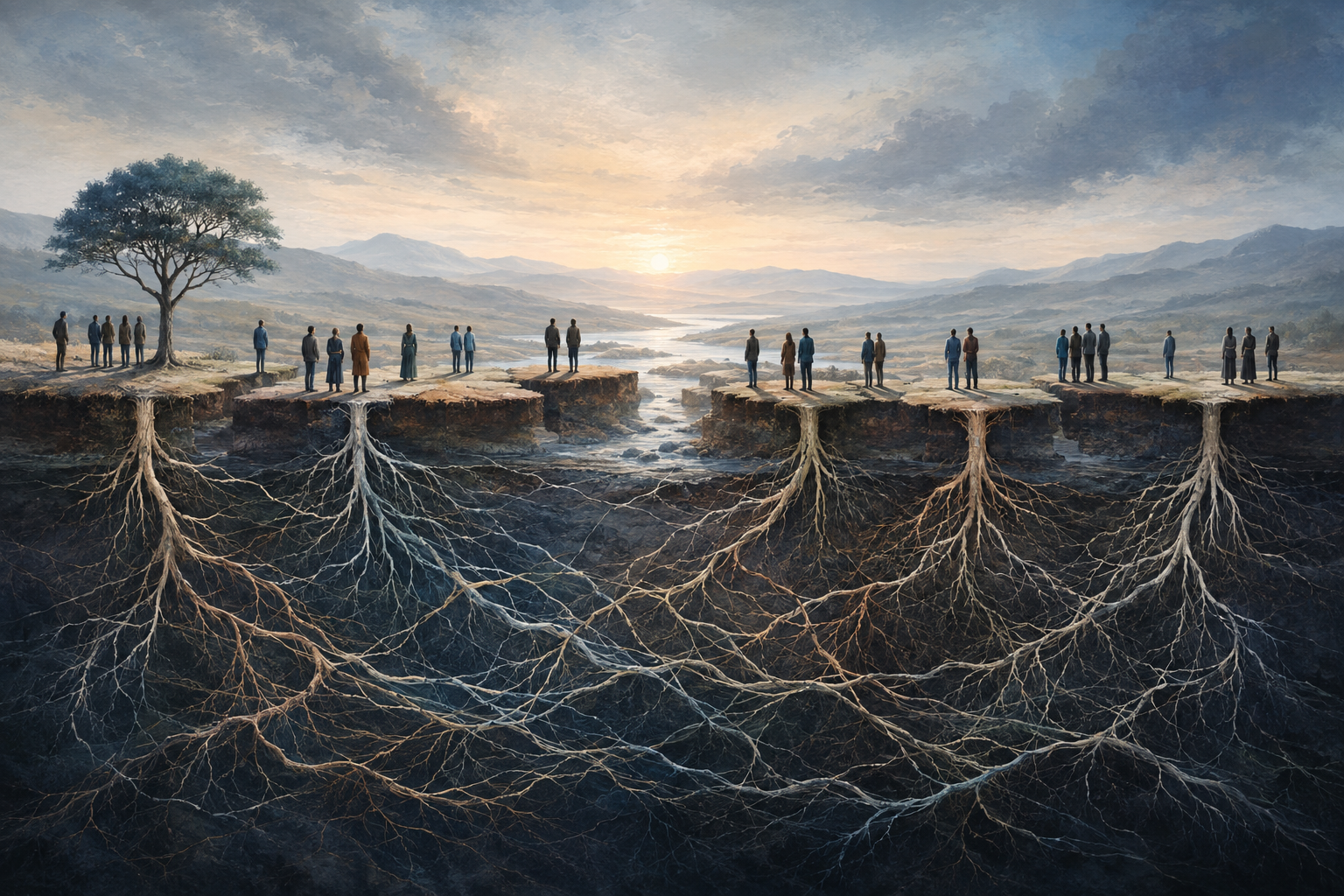
When we look at conflict in the world, we usually focus on the obvious reasons.
Politics. Money. Religion. Culture. Power. Rights. Government. War.
Those things matter, but I think they are often the visible part of something deeper.
Before there is an action, there is usually a thought.
Before there is a movement, there is an idea.
Before there is a government or political system, there is a belief about how people should live.
That means one useful way to understand conflict is to look beneath the actions and ask:
What ideas are driving them?
Different Ideas About People
One pattern I keep noticing is the tension between individuality and unity.
Some philosophies place a strong emphasis on the individual. They focus on personal freedom, individual responsibility, private choices, and the rights of each person.
Other philosophies place more emphasis on the group. They focus on collective responsibility, social unity, shared goals, and what benefits the whole.
You can see versions of this tension in politics, philosophy, religion, economics, and even arguments about the nature of consciousness.
But neither side of that spectrum is automatically good or evil.
Individualism can be used to defend human dignity and freedom. It can also become selfishness.
Unity can produce cooperation, community, and shared responsibility. It can also become control or suppression of the individual.
So the important question is not simply:
Is this individualist or collective?
The more important question is:
What is the goal?
Look at the Goal
Suppose two groups disagree about something important.
Instead of immediately deciding that one group is good and the other is bad, we can ask several questions.
What does each group want?
Why do they want it?
What view of human beings is behind their position?
What methods are they willing to use?
What happens if their ideas are carried all the way through?
Those questions move the discussion deeper than political labels.
A person can want something good but pursue it in a harmful way.
A person can also support something harmful while sincerely believing it is good.
Groups are even more complicated because they contain thousands or millions of people with different motives.
That is why human conflict becomes tangled.
Conflict Scales Up
Imagine a simple conflict between two people.
Imagine a simple conflict between two people. One wants to share a limited resource equally. The other believes it should go first to the person who needs it most.
At that scale, the moral issue may seem obvious.
But people form groups.
Groups form movements.
Movements form institutions.
Institutions create laws and governments.
Eventually, ideas that started with individuals can affect entire societies.
The scale changes, but the same basic questions remain:
What is the idea? What is its goal? And what does it produce?
That is where the deeper analysis begins.
We should not simply ask which side someone belongs to.
We should ask what is influencing the ideas themselves.
And that leads to an even deeper question:
Is there a moral foundation beneath all of these competing ideas?
That is where the Christian perspective enters the discussion.
Attuned Mind
Articles that help us work toward psychological wellbeing through the understanding an insightful philosophical perspective can offer.
About the journal